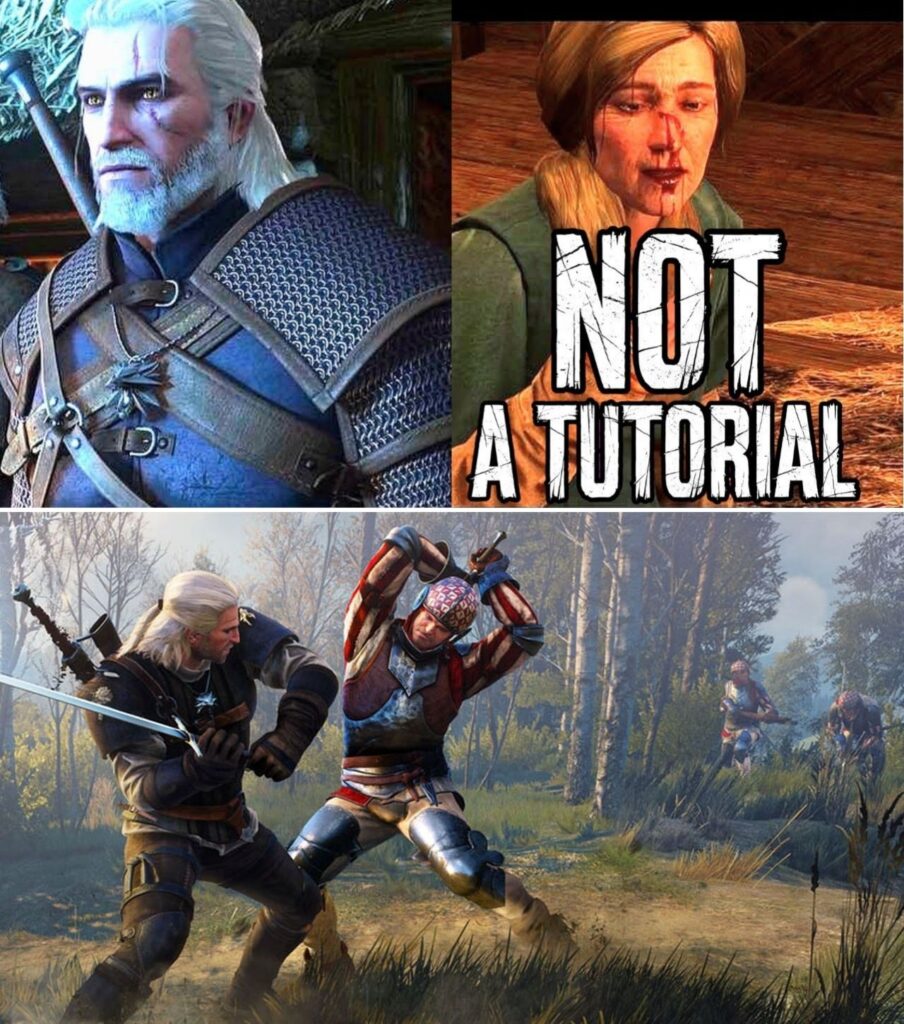



Stop lying to yourself: You completely missed the REAL story behind The Witcher 3‘s opening area. 😳💥
Gamers are currently losing their minds on Reddit and YouTube after a bombshell narrative breakdown exposed CD Projekt RED’s hidden brilliance in White Orchard. Everyone thinks White Orchard is just a basic “kill the Royal Griffin” tutorial to learn combat mechanics. In reality? It’s a masterclass in psychological occupation and war crime—and you participated without even noticing.
Think about it: Why did a simple taverngoer accuse the innkeeper Elsa of being a “Nilfgaardian wh0re” over a blank wooden wall? Why did taking 15 Nilfgaardian crowns for a contract make Geralt complicit in a farmer getting 15 brutal lashes for rotten grain? And why does the tavern get permanently shut down—leaving you drenched in blood right as Yennefer arrives with black-armored escorts?
CDPR didn’t just teach you how to draw your steel sword—they tricked you into becoming an enforcer for an invading empire before you even stepped foot into Velen.
The detail on the tavern wall changes EVERYTHING about how you view Geralt’s neutrality… Read the full breakdown here 👇🔥
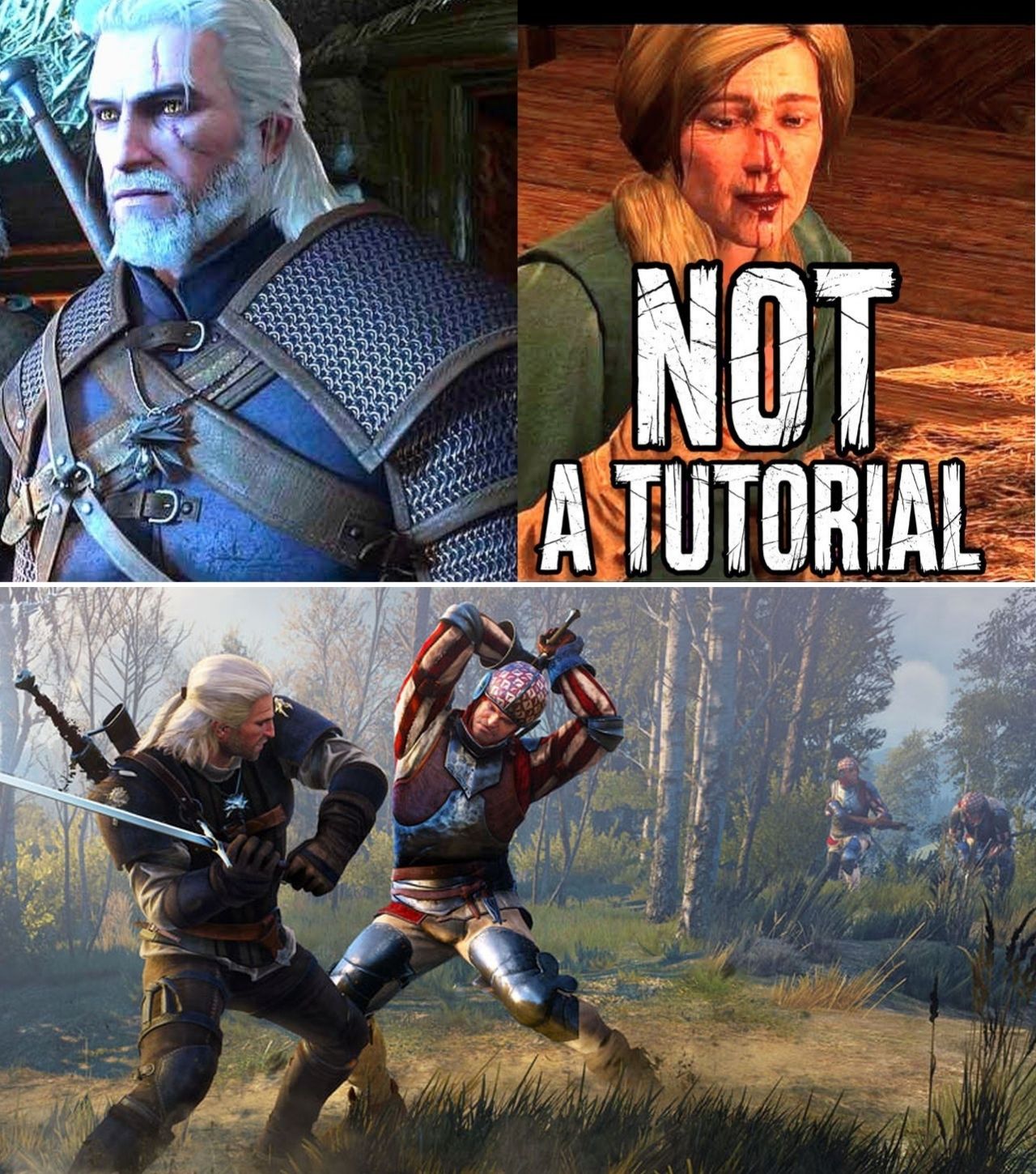
For nearly a decade, millions of action-RPG enthusiasts have treated White Orchard—the prologue area in CD Projekt RED’s landmark title The Witcher 3: Wild Hunt—as little more than a routine gameplay tutorial. Players typically rush through its mud-slicked roads to master basic mechanics: casting Signs like Igni or Quen, brewing Swallow potions, and slaying a dangerous Royal Griffin terrorizing the region.
However, a viral video essay by gaming analyst Unlived Saga, titled “Witcher 3’s Tutorial Is Actually Genius,” has sparked a massive re-evaluation across YouTube and X (formerly Twitter). The analysis demonstrates that White Orchard is not a monster-hunting tutorial at all—it is a sinister, masterfully crafted tutorial on military occupation, totalitarian control, and moral corruption.
Through subtle environmental storytelling, subtle dialogue cues, and clever quest design, CD Projekt RED quietly forces players to experience the crushing realities of the Third Northern War—and subtly turns Geralt of Rivia into a paid instrument of the invading Empire.
Here is a forensic breakdown of how The Witcher 3 tricks players in its opening hours, and why the gaming community is calling it one of the most brilliant storytelling choices in modern gaming history.
1. The Whip and the Coin: The Nilfgaardian Garrison
The true psychological framing of White Orchard occurs inside the Nilfgaardian Army Garrison at the northern edge of the map. When Geralt meets the Nilfgaardian Commander, Peter Saar Gwynleve, to gather information about Yennefer of Vengerberg, players witness a stark moment of authoritarian justice.
A local peasant farmer brings in his grain quota, only for the commander to inspect it and find it moldy and unusable. Without missing a beat or raising his voice, Commander Gwynleve cites Article 2, Section 3 of the Military Codex and mandates a sentence of 15 lashes. The punishment is delivered not out of malice, but as cold, routine bureaucratic paperwork.
Seconds later, Gwynleve turns to Geralt, hands him a pouch of Nilfgaardian crowns for killing the Royal Griffin, and states: “I don’t want you to say you were inadequately compensated.”
“One hand whips the peasant for a ruined harvest, while the other hand pays the Witcher,” noted Unlived Saga in the breakdown. “Virtually every player accepts the gold without thinking because they need gear. But the moment you take that coin, you are officially inside the Imperial war machine. You are taking money from the exact same army whipping starved locals.”
2. The Empty Wall and Community Self-Policing
Perhaps the most potent visual symbol in White Orchard is found inside the White Orchard Tavern. On the back wall of the establishment sits a blank wooden space with a single exposed nail.
Where the blue-and-silver lily banner of Temeria once hung, there is now nothing. The innkeeper, Elsa, explains that she took her nation’s flag down out of raw survival: if she displays Temerian colors, Nilfgaardian patrols will burn her tavern to the ground. Yet she refuses to replace it with the Nilfgaardian Sun.
This empty wall acts as a catalyst for human paranoia. A local woman in the tavern confronts Elsa, branding her a traitor and a “Nilfgaardian whore” simply for removing the flag. The woman reveals that Nilfgaardian soldiers hanged her sister—a midwife who previously saved Elsa’s own infant son during childbirth—for “superstition.”
Without a single Nilfgaardian soldier present in the room, the villagers tear each other apart out of fear and displacement. As gaming commentators point out, this illustrates the true mechanics of occupation: an invading army doesn’t need soldiers in every tavern when terror forces citizens to police and persecute one another.
3. Steel for Humans: The White Orchard Tavern Brawl
The prologue reaches its bloody climax when three drunk Temerian loyalists enter the tavern. Furious at the loss of their kingdom and misinterpreting Geralt and Vesemir’s presence, they hurl classic slurs—calling Geralt a “freak” and a “child-stealer”—and accuse the Witchers of serving Emperor Emhyr var Emreis.
Ironically, the drunkards are technically correct. Geralt does work for Emhyr; he accepted Nilfgaardian gold just minutes prior.
The game forces the player to draw their steel sword—establishing early on that steel is reserved for human monsters. Geralt and Vesemir slaughter the Temerians in self-defense, leaving blood splattered across the floor.
When the fight ends, Elsa does not thank Geralt. Distraught and terrified, she banishes Geralt from the tavern forever. The fight permanently closes the business, forcing Elsa to flee White Orchard entirely. (Players later encounter her as a displaced refugee working in Novigrad). Geralt wins the brawl, but completely destroys the livelihoods of the people he attempted to protect.
4. The Exit Shot: Yennefer and the Black Escort
As Geralt steps out of the ruined tavern soaked in human blood, he is greeted by Yennefer of Vengerberg, who arrives with a heavy escort of Nilfgaardian cavalry dressed in black armor.
Yennefer jokes about Geralt’s blood-soaked appearance, completely indifferent to the slaughter that took place inside. At this moment, the narrative connection snaps into place:
-
The local farmer works for Nilfgaard under threat of the whip.
-
Elsa submits to Nilfgaard under threat of fire.
-
Geralt works for Nilfgaard for gold.
-
Yennefer works for Nilfgaard to track down Ciri.
Four disparate figures, driven by completely different motives, all serving the same imperial tyrant.
Community Reaction: Why It Matters Today
On gaming hubs like Reddit’s r/witcher, fans have reacted with renewed awe toward CDPR’s writing team, comparing White Orchard to environmental storytelling benchmarks set by games like Dark Souls and Red Dead Redemption 2.
“Most open-world games use their opening area to teach you button layouts—press X to swing your sword, press Y to dodge,” wrote one top commenter. “White Orchard teaches you context. By the time you get to Velen and see bodies hanging from trees, you already understand how the machine works because you watched the gears turn in White Orchard.”
As players continue to revisit The Witcher 3: Wild Hunt – Next-Gen Edition, the lesson of White Orchard remains clear. The real monster of the prologue was never the Royal Griffin flying over the fields. The griffin was simply a wild beast acting on instinct. The true tragedy was the empty nail on the wall—and the human cruelty that rushed in to fill the void.

Leave a Reply