


🚨 BEFORE CAPTAIN PICARD LED THE ENTERPRISE, HE WAS WIELDING A PUG INTO BATTLE IN ONE OF THE WILDEST SCI-FI EPIC FAILURES EVER CREATED! 🐶⚔️
You think you know Sir Patrick Stewart? Think again. Three years before he ever sat in the Captain’s chair on Star Trek: The Next Generation, the legendary actor was knee-deep in a multi-million dollar, hallucinogenic space epic that completely fractured Hollywood—and features a weaponized dog charging across the desert dunes.
Fans across Reddit, X, and Discord are currently losing their minds resurfacing this absolute fever dream of a blockbuster, debating whether it’s a misunderstood masterpiece or the most glorious cinematic disaster of the 1980s. Even wilder? Stewart himself looked completely unrecognizable, sporting a wild hairline and screaming lines of dialogue while gripping a literal pug like a firearm.
How did a future Starfleet icon end up in a movie so bizarre it forced theaters to hand out explanatory glossaries to confused audiences on opening night? And why are modern sci-fi fans desperately demanding a director’s cut of this cosmic chaos?
The behind-the-scenes studio warfare, lost footage, and cast reactions will leave your jaw on the floor.
👉 Click here to uncover the untold story of Patrick Stewart’s forgotten sci-fi juggernaut before it gets scrubbed from the internet! 🔥
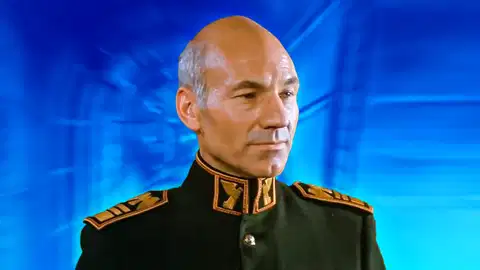
Long before Sir Patrick Stewart became a household name as the measured, philosophical Captain Jean-Luc Picard on Star Trek: The Next Generation, and decades before he redefined comic book cinema as Professor Charles Xavier, the classically trained Shakespearean actor found himself thrust into an entirely different kind of universe.
It was 1984. Director David Lynch, fresh off the critical acclaim of The Elephant Man, had taken on the seemingly impossible task of adapting Frank Herbert’s sprawling, philosophically dense sci-fi masterwork, Dune. Promoted as the ultimate sci-fi juggernaut to rival any space opera of its era, Dino De Laurentiis’ production was a colossal gamble. Among its eclectic, star-studded international cast was a relatively unknown British stage actor named Patrick Stewart, cast as the fierce, battle-hardened Gurney Halleck—a man who, in one unforgettable sequence, charges into galactic warfare with a small pug dog clutched defensively against his chest.
As internet film communities on Reddit’s r/movies and r/dune, alongside active Discord lore channels, continually revisit the 1984 adaptation, cultural fascination with Stewart’s pre-Trek sci-fi footprint has reached an all-time high. To understand Stewart’s journey to the USS Enterprise, one must first examine the high-stakes, chaotic crucible of Arrakis that nearly derailed—and ultimately defined—his trajectory in American popular culture.
The Genesis of a Cosmic Gamble
In the early 1980s, adapting Frank Herbert’s 1965 novel Dune was widely considered a cinematic impossibility. Alejandro Jodorowsky had famously spent years trying—and failing—to mount an LSD-soaked, 14-hour adaptation featuring Salvador Dalí and Orson Welles. When producer Dino De Laurentiis secured the rights, he handed the reins to David Lynch, an auteur whose sensibilities were rooted in surrealism and industrial grime, rather than clean-cut space exploration.
For Patrick Stewart, then heavily anchored in the Royal Shakespeare Company and British television, joining Dune was a pivot into a bizarre, high-budget Hollywood machine. Stewart was cast as Gurney Halleck, the loyal weapons master of House Atreides, mentor to Paul Atreides (played by Kyle MacLachlan), and a man equally adept at playing the baliset (a futuristic nine-stringed instrument) as he was at slaughtering Harkonnens.
Recalling the production decades later, cast members have frequently noted the sheer culture shock of shooting in the blistering heat of Mexican soundstages and deserts. For Stewart, who was accustomed to the rigid discipline of classical theatre, the massive scale of Dune offered an abrupt introduction to studio moviemaking on an epic, uncontrolled scale.
“When we were making Dune, none of us really knew what tectonic shift was happening in the sci-fi landscape,” shared a veteran Hollywood insider active in classic film preservation forums. “It was an art-house director trying to compress an encyclopedia into a two-hour-and-twenty-minute runtime. It was bound to fracture, but the actors played it with absolute, unyielding theatrical conviction.”
The Pug, the Baliset, and the Madness of Gurney Halleck
What keeps 1984’s Dune perpetually alive in digital discourse is its unbridled commitment to the strange. While Denis Villeneuve’s modern two-part adaptation leans into sleek, monolithic minimalism, Lynch’s film reveled in baroque, grotesque texture—biological machinery, oozing hearts, floating villains, and Gurney Halleck’s emotional bond with a pug.
In the film, Stewart plays Halleck with a booming intensity that teeters on the edge of manic camp, yet remains entirely anchored by his formidable screen presence. Whether shouting tactical maneuvers or brandishing a weapon while holding a bewildered dog through explosions, Stewart’s performance demanded attention.
Social media reactions on X (formerly Twitter) frequently highlight this specific era of Stewart’s career with a mixture of irony and deep affection. Viral threads regularly juxtapose the dignified, tea-drinking Captain Picard of 1987 with a sweat-drenched, scar-faced Gurney Halleck roaring into a sci-fi firefight.
“People forget that before Patrick Stewart became the gold standard of sci-fi leadership, he was essentially a space-pirate Shakespearean soldier screaming about spice and hauling a dog into combat,” noted one prominent film historian on a viral Reddit thread that amassed tens of thousands of upvotes. “It’s the ultimate acting whiplash, and it proves how versatile he always was.”
The Box Office Fallout and the Pivot to Starfleet
Upon its release in December 1984, Dune was met with a harsh critical reception and underwhelming box office returns, grossing roughly $30.9 million against a massive $40 million budget. Audiences unfamiliar with Herbert’s dense lore found the plot impenetrable—so much so that theaters famously handed out printed glossaries of terms like Bene Gesserit, Kwisatz Haderach, and Mentat just so moviegoers could follow the exposition.
For a brief moment, it appeared that Hollywood’s appetite for high-concept, adult-oriented space epics had hit a dead end. Stewart returned to his theatrical roots, seemingly detached from the futuristic visions of Hollywood.
However, fate intervened just three years later. In 1987, producer Robert H. Justman caught Stewart performing at a literary reading at UCLA. Recognizing a commanding, authoritative presence with a voice that could command an entire room, Justman pushed for Stewart to audition for a risky television revival: Star Trek: The Next Generation.
Stewart, who famously knew nothing about the original 1960s Star Trek series or its massive cultural footprint, initially viewed the gig as a short-term American paycheck. He didn’t even unpack his luggage when he moved to Los Angeles, fully expecting the series to be canceled quickly. Instead, TNG ran for seven grueling seasons and spawned four feature films, cementing Stewart’s legacy permanently into the cultural bedrock of science fiction.
A Lasting Legacy in the Shadow of Arrakis
Looking back from the vantage point of contemporary media, pop culture critics often view Dune (1984) as a crucial stepping stone. Without Stewart flexing his sci-fi credentials in Lynch’s universe, the transition from classical English stage actor to interstellar captain might have seemed far too steep a gamble for network television executives in the late ’80s.
Furthermore, as the modern Dune franchise dominates global box offices under Villeneuve, interest in the 1984 original has undergone a massive cultural renaissance. Fans and pop culture archivists routinely comb through archival footage of Stewart on the set of the original film, analyzing how those grueling months in Mexico prepared him for the intense physical and emotional demands of leading a long-running sci-fi television franchise.
While Star Trek: The Next Generation ultimately became the defining anchor of his legacy, Dune remains the glorious, unhinged anomaly that proved Patrick Stewart could command the stars long before he ever called for warp speed. As internet fandoms continue to unearth lost clips, promotional interviews, and behind-the-scenes lore, Gurney Halleck’s pug-toting charge across Arrakis stands frozen in time—a brilliant reminder of the unpredictable paths that lead actors to legendary status.

Leave a Reply