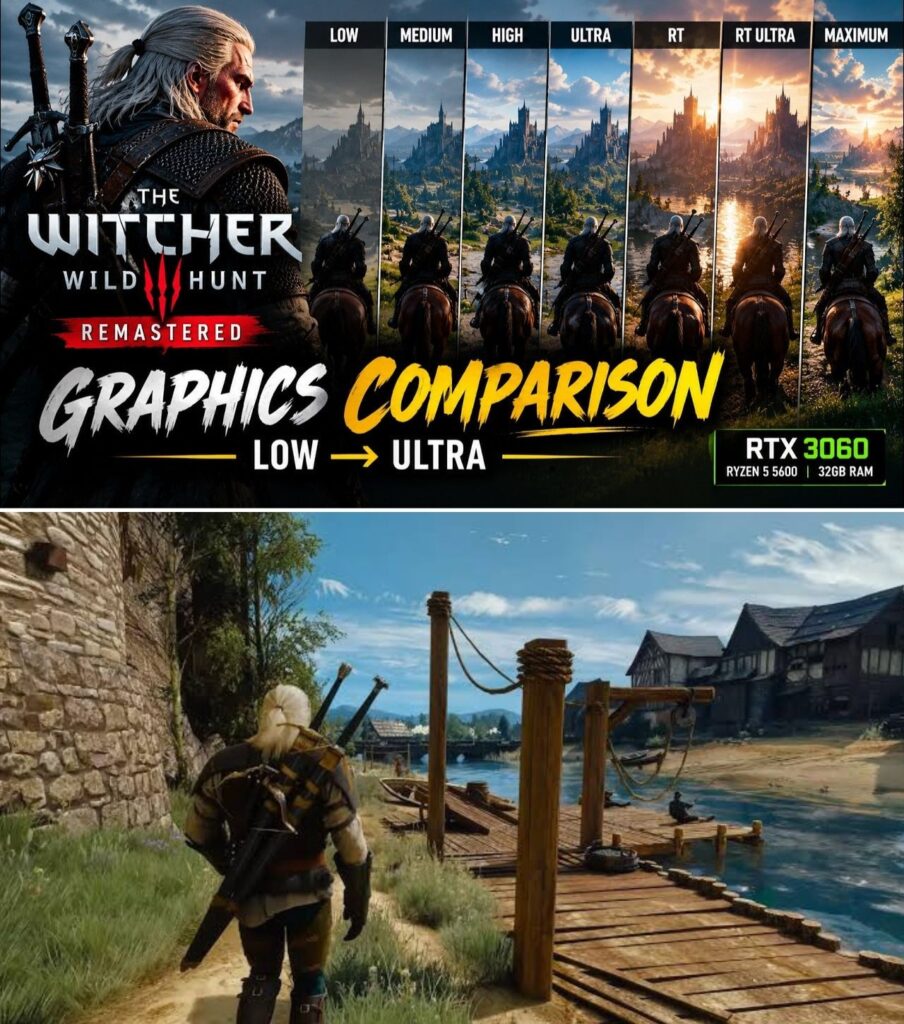



🚨 IS YOUR GPU ABOUT TO EXPLODE?! THE WITCHER 3 REMASTERED GRAPHICS TRAP EXPOSED! 🤯
Gamers are losing their minds over the latest hardware benchmark tests, and the results are straight-up terrifying. Running Geralt of Rivia across White Orchard on an RTX 3060 sounds safe on paper, but flipping those settings from Low to Ultra, and all the way to Ray Tracing Ultra is turning mainstream rigs into absolute ticking time bombs.
We’re talking about massive frame-rate collapses, brutal micro-stutters, and visual shifts so dramatic that standard Ultra mode looks like a completely different generation compared to RT Ultra. While optimized DLSS and FSR presets try to save the day, players pushing full Ray-Traced Global Illumination and Ray-Traced Reflections are finding out the hard way whether their mid-range hardware can actually survive CD Projekt Red’s next-gen overhaul—or if their fans are about to lift off like a jet engine.
Is Ray Tracing Ultra worth the massive performance tax, or is it a trap designed to force premature hardware upgrades? 👇🔥
👉 Uncover the full performance breakdown, setting comparisons, and why the PC community is split right here:
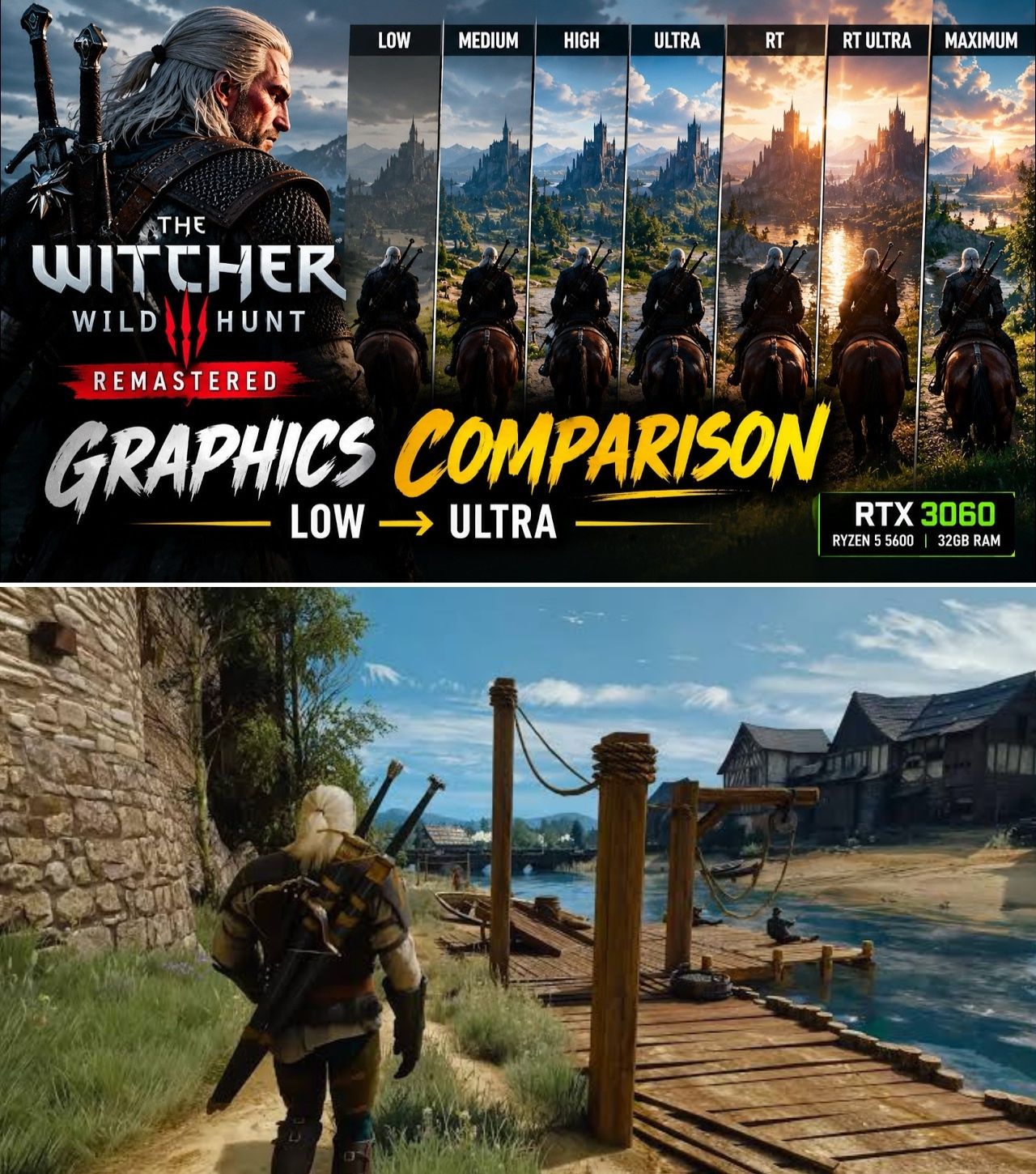
When CD Projekt Red unleashed the Next-Gen Update for The Witcher 3: Wild Hunt, it was heralded as a triumphant love letter to PC and console gamers alike. Breathing new life into White Orchard, Velen, and Toussaint with modernized textures, integrated community mods, and advanced hardware ray-tracing, the remaster elevated a 2015 masterpiece into a modern visual powerhouse. Yet, years after its launch, the debate surrounding optimization, hardware scalability, and the true cost of fidelity has never been fiercer. Recent extensive benchmarking analyses—focusing on ubiquitous mid-range GPUs like the NVIDIA GeForce RTX 3060—have laid bare the stark reality of scaling the game from Low presets all the way up to Ray Tracing Ultra.
The Graphical Spectrum: From Performance Compromises to Visual Splendor
The core of the recent performance discourse centers on how drastically the game transforms across its various preset tiers. For players utilizing mainstream hardware configurations, navigating the settings menu is a delicate exercise in balancing visual fidelity against frame-rate stability.
At the Low preset, The Witcher 3 Remastered strips away complex environmental shadowing, reduces foliage density, and minimizes background character rendering distances. While the Continent loses much of its lush, atmospheric density, the game achieves high, uninterrupted framerates, making it playable on older or budget-constrained systems. Transitioning to Medium and High presets introduces improved texture filtering, higher-resolution shadow maps, and moderately enhanced grass density, striking a functional middle ground for players seeking visual clarity without crippling their GPU’s processing pipelines.
However, crossing the threshold into Ultra and subsequently activating Ray Tracing (RT) and RT Ultra shifts the game into an entirely different computational weight class. Ray-Traced Global Illumination (RTGI) fundamentally alters how light interacts with Geralt’s environment, replacing pre-baked ambient lighting with dynamic, physically accurate light bounces. When combined with Ray-Traced Reflections (RTR) on water surfaces and polished armor sets, the visual fidelity is staggering—yet it exacts a punishing toll on hardware not equipped with advanced tensor cores.
The RTX 3060 Benchmark Dilemma: Can Mainstream Hardware Survive RT Ultra?
As one of the most widely adopted graphics cards in Steam hardware surveys, the NVIDIA GeForce RTX 3060 serves as an ideal litmus test for mainstream PC gaming capability. Recent side-by-side graphical comparisons running on this specific GPU highlight the acute tension between artistic ambition and hardware limitations.
When pushing settings to RT Ultra—incorporating ray-traced shadows, ambient occlusion, and global illumination—frame rates on an RTX 3060 experience severe contraction. Without the assistance of smart upscaling technologies like NVIDIA DLSS (Deep Learning Super Sampling) set to Quality or Balanced modes, native resolution rendering under full ray tracing causes framerates to plummet below acceptable thresholds, introducing disruptive stutter during fast-paced mounted exploration and combat encounters against packs of ghouls or bandits.
Community discussions across Reddit, hardware forums, and Discord channels reflect deep divisions over this performance tax. Defenders of the remaster argue that features like RT Ultra are intentionally designed as future-proof graphical targets, meant to be scaled using DLSS, FSR (FidelityFX Super Resolution), and frame-generation tools. They contend that players unwilling to compromise on resolution or utilize upscaling are clinging to outdated expectations for mid-range hardware.
Conversely, critics point out that the performance disparity between standard Ultra and Ray-Traced modes often feels disproportionate to the visual gains in motion. In fast-paced gameplay, subtle improvements in indirect lighting bounces or ray-traced water reflections can easily go unnoticed, leading many players to disable heavy ray-tracing options in favor of a locked, fluid framerate.
The Broader Implications for Open-World Optimization
The ongoing scrutiny of The Witcher 3 Remastered highlights a broader, industry-wide challenge: the friction between aging mainstream hardware and increasingly ambitious rendering techniques. As developers lean heavier into global illumination, ray-traced shadows, and complex shader compilations, the burden on VRAM and compute units continues to escalate.
For now, Geralt’s journey remains the ultimate benchmarking playground for PC enthusiasts. Whether players choose to run the game stripped down for maximum performance or maxed out with cutting-edge lighting shaders, the title continues to provoke vital conversations about optimization, accessibility, and the evolving definition of next-gen standards.

Leave a Reply