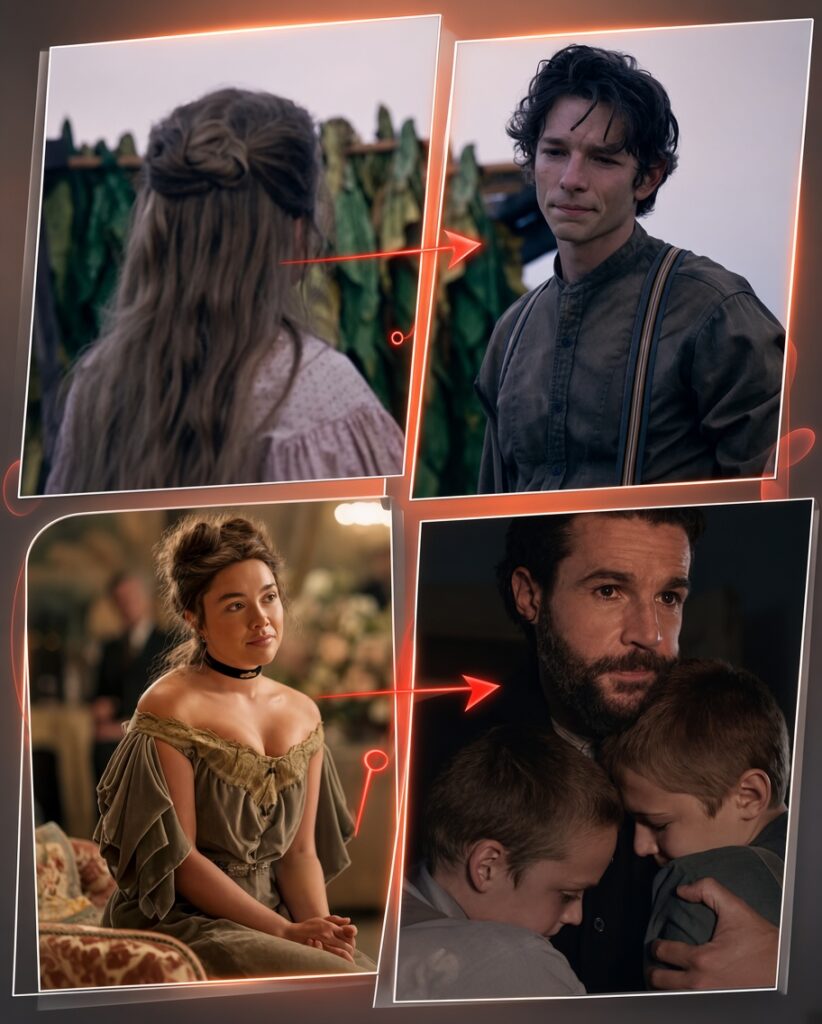



🚨 “THE SAME WOMAN, TWO BROTHERS… AND A DEVIL IN SILK.” 🚨
Netflix’s East of Eden just dropped the most dangerously toxic love triangle in television history—and fans are losing their absolute minds! 🩸🥀👀
When Cathy Ames (Florence Pugh) crawls onto the Trask doorstep covered in blood, Adam Trask sees a fragile, innocent angel who needs saving. But his brother Charles? He looks into her eyes and sees the exact same darkness that lives inside HIM. 😳🔥
While Adam falls hopelessly in love with a woman who doesn’t exist, Charles engages in a mind-bending game of psychological chess that threatens to destroy their entire family. The internet is fiercely divided: Is Cathy a pure monster manipulating two naive brothers, or are Adam and Charles simply projecting their own deep-seated childhood trauma onto her? 🐍💔
What dirty secret passed between Charles and Cathy behind Adam’s back? Why is Adam completely blind to the red flags slapping him in the face? And which brother was ACTUALLY ruined by her arrival?
The debate on Reddit and TikTok is getting brutally personal… 👇💥
🔥 Read the full deep-dive breakdown, dark character analysis, and fan theories HERE:
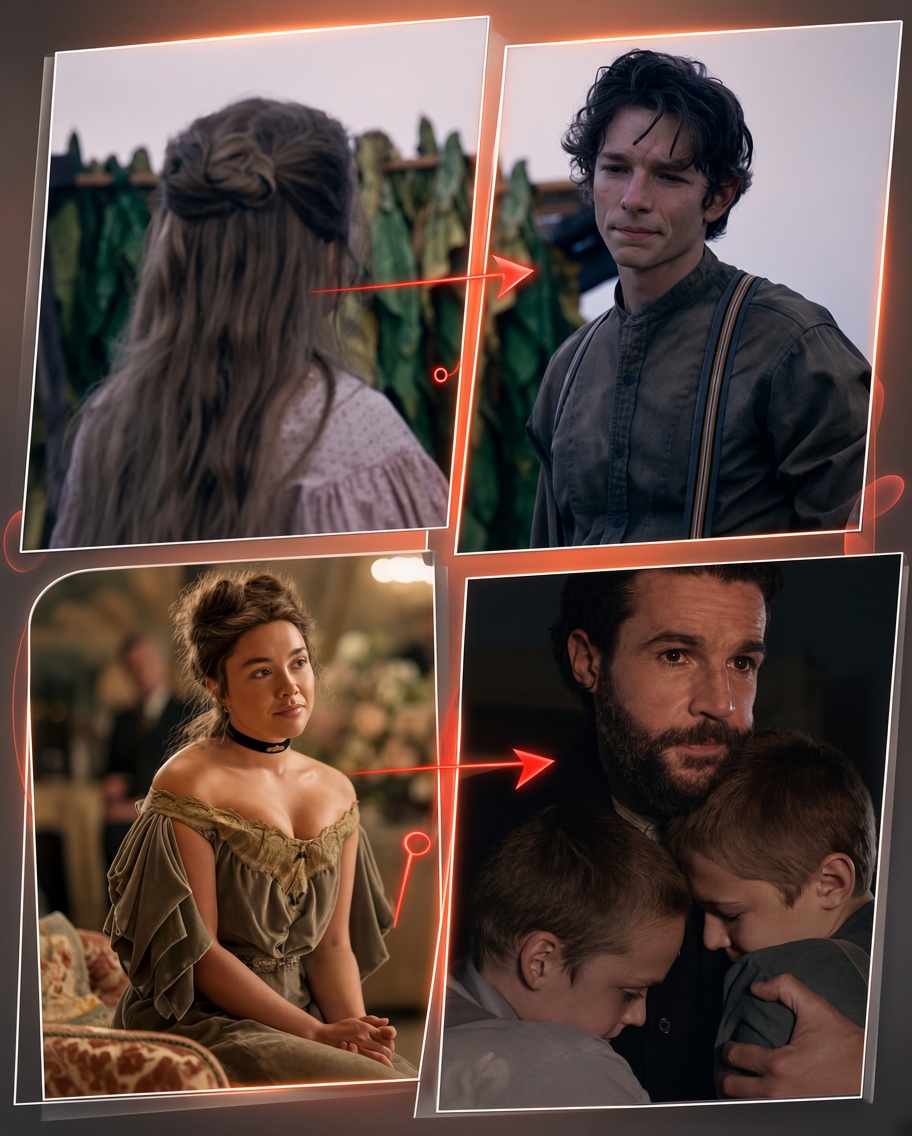
When John Steinbeck published his magnum opus East of Eden in 1952, he created what many literary scholars consider the ultimate modern retelling of the biblical Cain and Abel allegory. Fast forward to Netflix’s critically acclaimed seven-part limited series adaptation, showrunner Zoe Kazan has breathed new, intoxicating life into this classic struggle by centering the psychological vortex that is Cathy Ames (portrayed with terrifying, razor-sharp precision by Florence Pugh).
At the heart of the series’ gripping narrative lies the deeply tangled, inherently dysfunctional dynamic between Cathy and the two Trask brothers: Adam (Christopher Abbott) and Charles (Mike Faist). When an injured, bleeding Cathy arrives at the Trask homestead, her presence acts as a catalyst that detonates years of buried family resentment, sibling rivalry, and unhealed childhood trauma.
Yet, what makes Netflix’s adaptation particularly fascinating to modern audiences—and a hotbed for endless social media debate—is the stark, almost polar contrast in how Adam and Charles perceive, interact with, and fall victim to the very same woman.
                  ┌──────────────────────────────────────────────┐
                  │          CATHY AMES (Florence Pugh)          │
                  │   Sociopathic, Manipulative, Enigmatic      │
                  └──────────────────────┬───────────────────────┘
                                         │
         ┌───────────────────────────────┴───────────────────────────────┐
         ▼                                                               ▼
┌─────────────────────────────────┐                             ┌─────────────────────────────────┐
│     ADAM TRASK (Chris Abbott)   │                             │    CHARLES TRASK (Mike Faist)   │
├─────────────────────────────────┤                             ├─────────────────────────────────┤
│ • Blended by idealization       │                             │ • Sees her true, dark nature    │
│ • Projects innocence onto her   │     PSYCHOLOGICAL TENSION    │ • Driven by raw, cynical desire │
│ • Blind to obvious red flags    │ ◄─────────────────────────► │ • Recognizes a kindred spirit   │
│ • Victim of spiritual illusion  │                             │ • Dangerously attracted to dark │
└─────────────────────────────────┘                             └─────────────────────────────────┘
The Angel vs. The Mirror: How the Brothers See Cathy
Adam Trask: The Tragedy of Blind Idealization
For Adam Trask, Cathy Ames is not a human being with flaws, secrets, or agency; she is an idol. Having survived a childhood defined by his father Cyrus’s cold favoritism and his brother Charles’s brutal jealousy, Adam possesses a desperate need for purity and goodness.
When he finds Cathy battered on their porch, Adam immediately constructs a romantic fantasy. He views her as a spotless, fragile creature who requires protection. In Adam’s eyes:
-
Cathy is a saint: He projects his own longing for innocence onto her, refusing to question her mysterious past or suspicious behavior.
-
Love is a shield: He believes that by marrying her and creating a suburban Eden in California’s Salinas Valley, he can cure her wounds and his own past trauma.
-
Denial as a lifestyle: Even as subtle warning signs emerge, Adam’s psychological defense mechanisms actively block out reality, making his eventual betrayal all the more devastating.
Charles Trask: The Instinct of the Predator
In sharp contrast, Charles Trask possesses an uncanny, almost animalistic intuition. Molded by dark impulses, violent outbursts, and a deep-seated belief that he is fundamentally unlovable, Charles recognizes Cathy’s true nature almost instantly.
Where Adam sees an angel, Charles sees a fellow predator in disguise:
-
Mutual Recognition: Charles senses that Cathy’s helplessness is a calculated act. He isn’t fooled by her soft voice or submissive posture.
-
Dark Attraction: Because Charles accepts his own internal darkness, he is magnetic to Cathy’s sociopathy. Their interactions are loaded with unspoken recognition—a shared understanding of the cynical, predatory side of human nature.
-
Temptation and Betrayal: The tension between Charles and Cathy culminates in moments of intense psychological and physical betrayal that shatter the fragile peace between the two brothers forever.
Fandom Meltdown: Reddit, TikTok, and X Debates
The nuanced portrayal of this toxic triad has sparked passionate discourse across social media platforms, with viewers dissecting every frame of Florence Pugh, Christopher Abbott, and Mike Faist’s performances.

Reddit: The Psychology of Projection
On r/EastOfEden and r/Television, fans have engaged in lengthy analyses regarding the tragedy of Adam’s ignorance versus Charles’s cynical clarity.
“The absolute genius of Steinbeck’s writing—and Zoe Kazan’s adaptation—is that Cathy doesn’t even have to lie that hard to Adam,” one top-voted Reddit comment reads. “Adam lies to HIMSELF. He uses Cathy as a canvas for his own savior complex, while Charles looks at her and sees a mirror of his own dark soul.”
TikTok and X: #TeamCharles vs. #TeamAdam
On TikTok and X, the discourse has taken a distinctly modern, character-driven turn. Video edits contrasting Adam’s gentle, delusional adoration with Charles’s dangerous, electric chemistry with Cathy have garnered millions of views.
Many viewers applaud Florence Pugh’s ability to calibrate her performance differently depending on which brother is in the room—appearing helpless and soft around Adam, yet cold, calculating, and seductive around Charles.
Comparative Analysis: The Two Facets of Love in ‘East of Eden’
To understand why Cathy Ames destabilizes the Trask family so completely, one must look at how the series contrasts two fundamentally broken approaches to affection:
| Dimension | Adam Trask’s Love | Charles Trask’s Attraction |
| Foundational Emotion | Idolatry, Savior Complex, Delusion | Raw Instinct, Shared Darkness, Cynicism |
| Perception of Cathy | An innocent angel needing salvation | A dangerous, calculating survivor |
| Impact on the Sibling Dynamic | Isolates Adam into a world of fantasy | Re-ignites intense jealousy and resentment |
| Narrative Symbolism | The tragic blindness of moral perfectionism | The destructive pull of inherited sin |
The Broader Impact: Reimagining Steinbeck for a New Generation
Netflix’s East of Eden demonstrates that classic literature’s central themes—free will (Timshel), generational trauma, and the complex nature of evil—remain intensely relevant to contemporary audiences. By treating Cathy Ames not merely as a two-dimensional villain, but as a complex, destructive force operating within a flawed patriarchal world, the series invites viewers to question their own perceptions of morality and romantic idealization.
As the miniseries reaches its dramatic climax, the rift between Adam and Charles stands as a sobering reminder: the most dangerous illusions are often the ones we build to protect ourselves from the truth.

Leave a Reply