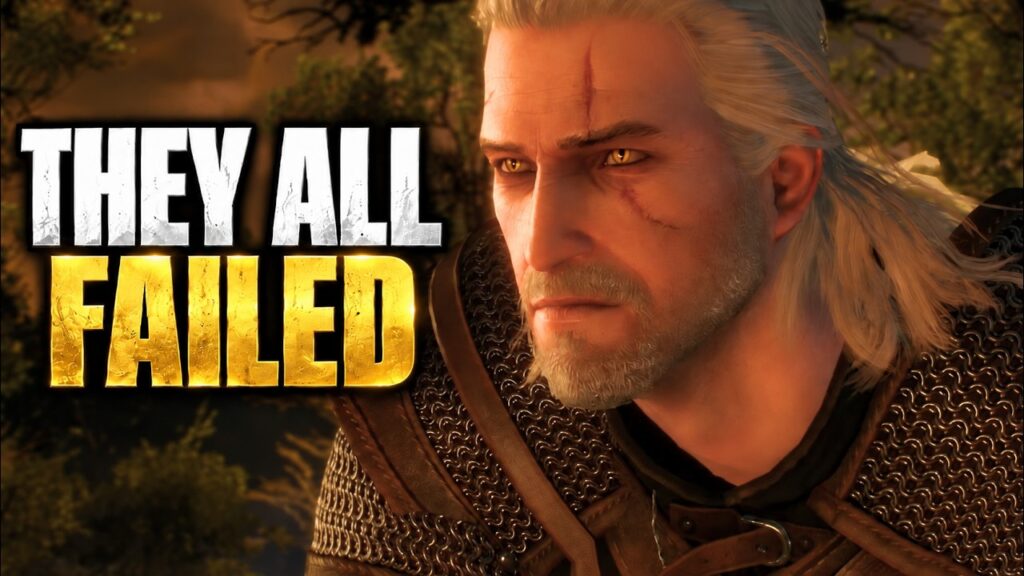



🚨 EVERY SINGLE RPG SINCE 2015 GOT THE WITCHER 3 COMPLETELY WRONG… AND WE HAVE PROOF! 🚨
For over a decade, massive studios have tried to copy CD Projekt Red’s magnum opus. They looked at 65 million copies sold and 251 Game of the Year awards, and what did they learn? They saw a big map, slapped down thousands of copy-paste question marks, inserted generic bounty boards, added hollow morality bars, and even sold $10 experience boosters just to skip their own bloated filler.
They copied the surface, but they completely missed the soul.
From Bethesda’s endless “another settlement needs your help” radiant loops to Ubisoft’s icon-cluttered Greek landscapes, modern RPG developers fundamentally misunderstood why Geralt of Rivia’s adventure still haunts us 11 years later. They gave us binary dialogue wheels and glowing halos instead of letting us live with the devastating, delayed consequences of freeing a trapped spirit at the Whispering Hillock or watching the Bloody Baron’s grim fate unfold.
Why did almost every triple-A studio fail to capture the magic of Crow’s Perch, and what are the 12 core design pillars everyone keeps butchering?
👇 Uncover the massive industry critique and see why every RPG got it wrong right here:
When The Witcher 3: Wild Hunt launched on May 19, 2015, it did not merely arrive as a commercial hit; it redefined the architectural blueprint of modern role-playing games. Selling over 65 million copies and hauling in an unprecedented 251 Game of the Year awards by early 2016, the Continental epic became the gold standard that every major studio scrambled to emulate.
In late 2018, Scott Phillips, the director of Assassin’s Creed Odyssey, openly cited The Witcher 3—alongside Skyrim and Fallout—as a primary inspiration for his team’s design philosophy. Yet, when Odyssey launched that October, it packaged dialogue choices and romances alongside a $10 store item designed to grant a permanent 50% experience boost, effectively letting players pay to bypass the very content the studio had built.
It was a telling symptom of a broader industry malady. Over the past eleven years, almost every major RPG has tried to copy something from The Witcher 3. Almost none of them did it successfully.
Chapter 1: The Side Quest Illusion (Quantity vs. Human Weight)
The most famous quest line in The Witcher 3 begins with a simple premise: Philip Strenger, the Bloody Baron ruling over Crow’s Perch, knows information about Ciri, but demands Geralt find his missing wife and daughter first. On paper, it is a textbook fetch quest.
What unfolds over the subsequent hours is a harrowing narrative exploring domestic abuse, a concealed miscarriage, three malevolent swamp crones, and a grieving father whose monstrous actions and tragic humanity bleed into one another. It concludes with the Baron either hanging himself from an oak tree or riding off into the mist with a wife who no longer recognizes him. There is no golden third option.
Reviewers in 2015 frequently wrote that The Witcher 3’s side quests were better than other games’ main stories. Studios read that acclaim and concluded that players simply wanted a lot of side quests.
Assassin’s Creed Odyssey responded with a massive map of ancient Greece, a relentlessly filling quest log, and a leveling system that aggressively gated narrative progression behind grinding side content. Bethesda took a different route with Fallout 4, leaning heavily on “radiant quests” that procedurally generated tasks—immortalized forever by Preston Garvey’s ubiquitous warning: “Another settlement needs your help; I’ll mark it on your map.”
While radiant quests ensured players never ran out of things to do, they prioritized pure quantity over narrative weight. The Bloody Baron is remembered years later for a botched miscarriage and a suicide; Preston Garvey is remembered as a calendar notification. Crafting a side quest that works requires centering it on a human being, not a map marker.
Chapter 2: The Fallacy of the Morality Meter
The Witcher 3 does not keep score. There is no karma meter, no paragon bar, and no audible chime to validate your ethical alignment. When Geralt encounters a trapped spirit beneath the Whispering Hillock, the choice is agonizing: free the ancient entity to save a house full of orphans, knowing it will slaughter the village of Downwarren and leave the Baron’s wife dead; or slay the spirit, sparing the village while condemning the children to the Crones.
The game never tells you which option is “correct.” You make the call long before you understand its full ramifications, often discovering the devastating fallout hours later in casual conversation.
The rest of the industry, however, became addicted to visual crutches. Fallout 4 introduced a fully voiced protagonist paired with a four-way dialogue wheel that frequently paraphrased responses, leading to unintended outcomes. Mass Effect Andromeda traded classic morality systems for emotional, logical, casual, and professional tones, focusing more on how Ryder spoke rather than the true cost of the decision. Even Hogwarts Legacy allowed players to wield Unforgivable Curses against human enemies without the surrounding wizarding world batting an eye.
True moral weight requires removing the safety net. When a game introduces a morality meter, players stop asking what the right thing to do is and start optimizing for the score, role-playing a floating number rather than a complex character.
Chapter 3: Delayed Consequences and the Art of Patience
One of The Witcher 3’s boldest design choices is its profound patience. Major political consequences—such as the fate of the Northern Kingdoms, the throne of Skellige, or the survival of characters like Keira Metz—frequently do not land until dozens of hours later, or surface quietly in the ending epilogue slideshow long after the initial choice has faded from memory.
Most modern competitors lean on immediate gratification. A choice is made, and the game instantly fires off a notification, sound cue, or pop-up text box to ensure you know an event occurred. Cyberpunk 2077 launched with three distinct life paths (Nomad, Street Kid, Corpo), yet after the prologue, those backgrounds largely boiled down to isolated dialogue flavor text before funneling all players down identical narrative tracks.
The few games that copied this patience successfully—such as Larian Studios’ Baldur’s Gate 3, where Act 1 decisions actively ripple into Act 3 forty hours down the line—proved that players respond deeply to a world that quietly remembers your actions without flashing neon signs in your face.
Chapter 4: The Anchor of a Fixed Protagonist
Geralt of Rivia is not a blank slate. Supported by decades of Andrzej Sapkowski’s source material and voiced with gravelly reluctance by Doug Cockle, Geralt arrives with a deeply established point of view. He finds kings tiresome, sorceresses complicated, and monsters largely misunderstood.
When developers attempted to give players custom or voiced avatars—such as Fallout 4’s Sole Survivor—they often stripped away fixed personality traits to accommodate open-ended role-playing, resulting in a voice actor recording lines that lacked a cohesive worldview. Conversely, action RPGs that copied Geralt’s gruff, bearded exterior often left out his dry, self-deprecating wit. Grumpy without jokes is simply exhausting. Geralt works because his dark humor and weariness make him genuinely good company for a hundred-hour journey.
Chapter 5: Contracts and the Death of Investigation
Witcher contracts represent one of the most widely imitated systems in modern gaming, yet they were frequently misunderstood. A standard contract begins with a notice board, an investigation utilizing Witcher Senses to track clues and consult bestiaries, preparation via oils and potions, a challenging fight, and—crucially—a narrative twist revealing that the monster is often the least complicated character in the tragedy.
While games like Horizon Zero Dawn successfully adopted the tactical preparation and weak-point scanning for fighting colossal machines, open-world staples like Assassin’s Creed reduced the investigative loop to following a brightly painted trail straight to an objective marker. The detective work vanished, leaving behind automated bounty boards that lacked local narrative context, human lies, or moral twists.
Chapter 6: Humor as Structural Relief
A common misconception among casual observers is that The Witcher 3 is relentlessly grim. In reality, it is one of the funniest RPGs in modern history, balancing political plague and war with the bickering banter of Dandelion, the unapologetic bluntness of Zoltan Chivay, and drunken nights at Kaer Morhen.
This humor performs vital structural work. If everything is grim, nothing is. Modern games that attempted to copy the “grimdark” aesthetic often discarded levity entirely, resulting in exhausting, humorless lectures. Conversely, titles that overcorrected into constant, Marvel-esque quips dissolved narrative tension entirely. The Witcher 3 succeeds because its humor remains organically tethered to its characters, ensuring that when tragedy strikes, the emotional impact hits with devastating force.
Chapters 7–12: From Companions and Worlds to Gwent and Expansions
The philosophy of The Witcher 3 permeates every other system it touches:
-
Companions: Rather than relying on continuous approval bars and item gifting (exemplified by meme-generating notification systems in titles like Starfield), allies like Zoltan or the defenders at Kaer Morhen show up because Geralt genuinely earned their loyalty through past deeds.
-
The World: While Skellige succumbed to an overabundance of repetitive floating smuggler caches, regions like Velen achieved density not through icon-cluttered checklists, but because every burned village and cave was intimately tied to human suffering and local gossip.
-
Gwent: What started as a charming tavern minigame was later mishandled by studios (including CDPR itself with standalone releases) that mistook a contextual distraction for a standalone competitive card market.
-
Expansions: Hearts of Stone and Blood and Wine established a gold standard for downloadable content, acting essentially as full standalone sequels rich in new regions and narrative depth—a standard starkly contrasted by overpriced season passes offering sparse cosmetic bundles.
-
Danger & Endings: By refusing to level-scale the entire world, the game preserved a genuine geography of danger. Similarly, Ciri’s ultimate fate is decided not by a final color-coded dialogue menu, but by ordinary parenting decisions—such as whether to throw snowballs or trash a laboratory together.
The Road Ahead: The Ultimate Test
As CD Projekt Red prepares to steer toward future horizons—including upcoming projects and The Witcher 4 with Ciri taking the lead—the studio faces a unique ironic challenge: the next developers with a chance to copy The Witcher 3 completely wrong are the ones who originally made it.
Eleven years after its initial release, running on hardware generations past, The Witcher 3: Wild Hunt remains a towering achievement not because of its ray-tracing tech or polygon counts, but because it dared to care about the human stories hiding behind the monster contracts. As long as future RPGs prioritize icon-filled checklists and morality meters over deeply flawed people, The Witcher will remain unmatched on the Path.

Leave a Reply